
Main political developments in Russia continue to revolve around preparations for the 2026 State Duma campaign. Within the presidential administration, discussions focus on the desired configuration of the party system and the electoral scenarios the Kremlin may pursue.
The key source of uncertainty remains Russia’s nearly four-year war against Ukraine and the growing public fatigue — a factor the authorities can no longer ignore. Against this backdrop, Russian officials claim the West is preparing to interfere in the elections, including by “discrediting” candidates who are war “veterans”.
Russian authorities introduce new mechanisms to legitimize the vote through tightly controlled “public monitoring” institutions and intensify pressure on the systemic opposition. Several regional branches of the Communist Party have come under pressure, but the Kremlin’s main target is Yabloko — the only party planning to run under the slogan “For Peace and Freedom!”. The first part of this November–December 2025 Election Update focuses on these developments.
In 2026, alongside the State Duma elections, seven regions will hold gubernatorial votes and 39 will elect new regional parliaments. To avoid fueling protest sentiment in the regions, the Kremlin has temporarily stepped back from another source of political tension — municipal reform, which aims to tighten political centralization even further.
At the same time, the reform’s long-term goals are becoming clearer. First, it aims to abolish the lowest level of local self-government by merging settlements into larger municipal districts. Second, the reform seeks to further consolidate the vertical of power by giving regional authorities the right to appoint and dismiss district heads and dissolve city councils. The second part of the Election Update focuses on this issue.
At its December Federal Council meeting, Yabloko officially announced it will run in the 2026 State Duma elections, despite unprecedented pressure on its members. The party’s campaign slogan will be: “For peace and freedom! For a life without fear!”
At the meeting, leaders of Yabloko detailed the scale of repression:
— 58 members of Yabloko party were fined (36 members fined for “discrediting” the Russian military), some of them multiple times
— 34 subjected to police house searches, plus 5 raids in regional offices
— 29 detained, 13 of them facing criminal charges
— 11 jailed under administrative arrest
— 7 members are currently behind bars
— 2 included on the “terrorists and extremists” list
— 10 labeled as “foreign agents”
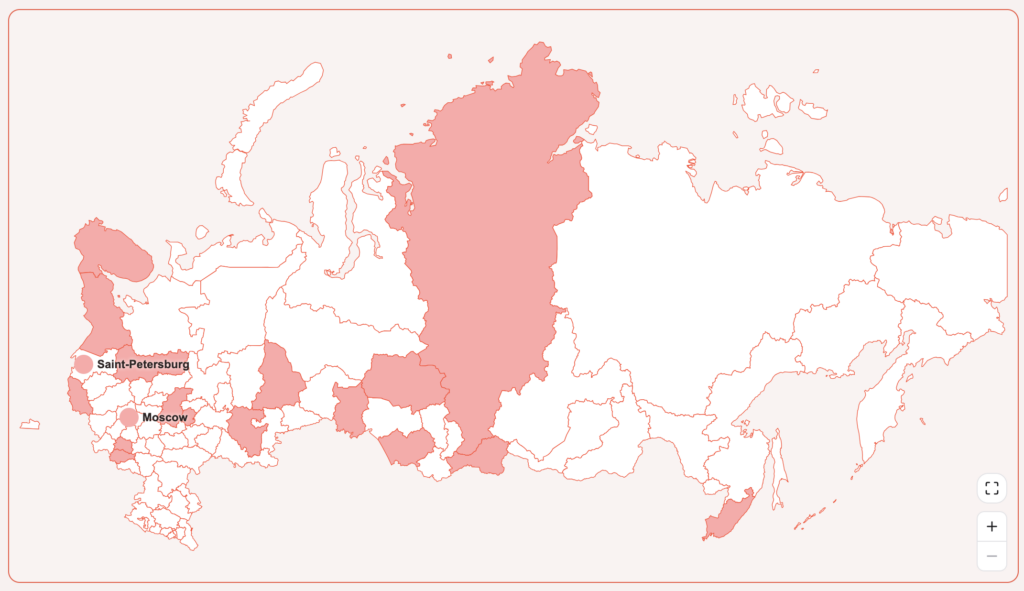
Over the past two months, criminal cases have been initiated against key Yabloko representatives, effectively decapitating the party’s leadership and several of its regional branches:
This wave of persecution has left Yabloko without a confirmed lead candidate. 2021 party list leader Nikolai Rybakov is barred from running due to a court ruling on “extremist symbolics”, while Grigory Yavlinsky, the party’s founder and a former presidential candidate, remains undecided about running in the Duma elections.
Popular media outlet Meduza suggests that the crackdown on Yabloko may be linked to the growing popularity of 2024 presidential candidate Boris Nadezhdin. Yabloko still enjoys a rare “Duma privilege”, which allows the party to run without collecting signatures. The Kremlin appears to be preparing for a tightly controlled campaign. Despite low ratings of 3-4%, some political technologists believe Yabloko could surpass the 5% threshold if it taps into public fatigue with Russia’s war in Ukraine. The Kremlin fears the party could become a rallying point for the moderate opposition or elevate figures like Boris Nadezhdin, who can attract disillusioned voters.
If that scenario materializes, officials could use procedural reasons to disqualify Yabloko’s list, despite its “Duma privilege”. One potential reason could be designating Yabloko as an extremist organization and liquidating it — Russian law allows the “extremist” status of individual members to extend to the entire party. Yabloko already has two such cases involving co-chairs Maksim Kruglov and Lev Shlosberg.
Pressure on the CPRF is also intensifying across Russia’s regions as the country moves toward the 2026 elections. In recent months, the hardest hit region has been Altai Krai.
A criminal case has been opened against Lyudmila Klyushnikova, a member of the regional parliament and first secretary of the Novoaltaysk City Committee of the Communist Party. Police searches were conducted at both her home and at the local CPRF office.
The formal pretext is a fraud case involving her assistant, Svetlana Kerber, who was previously placed in a detention center. Investigators claim that Kerber received a salary without performing her duties. Klyushnikova called the case against her assistant “a political crackdown”. CPRF State Duma deputy Maria Prusakova linked the pressure directly to the upcoming elections.
Later, Yury Kropotin, vice speaker of the regional legislature from the Communist Party, was taken to the Investigative Committee. The reasons for his interrogation remain unknown, and it is unclear whether a criminal case has been opened against him.
Altai Krai is one of Russia’s most protest-prone regions, where the CPRF consistently competes with United Russia. In the 2018 gubernatorial race, Kremlin-backed candidate Viktor Tomenko secured only 53%, narrowly avoiding a runoff. Meanwhile, Maria Prusakova — who could have been Tomenko’s strongest opponent — was blocked from running.
In the 2021 State Duma elections, United Russia received 33% in Altai Krai, while the CPRF gained 31%. Prusakova won one of the single-mandate districts. So-called spoiler parties, including the Communists of Russia and the Pensioners’ Party, each received around 2–2.5%. Observers noted that, without these spoiler votes, the CPRF could have won a majority of Duma seats.
In the 2021 regional elections, the CPRF gained 24% on party lists and won 15 single-mandate districts (United Russia took 19 districts).
Over the past weeks, several Russian regions have fully or partially abolished the lower level of local self-government — urban or rural settlements — merging them into larger municipal districts (so-called okrugs). This effectively eliminated elected local positions, such as settlement heads and local councils, leaving elected offices only at the higher, okrug level.
Regions that have recently completed the transition include Buryatia, Chechnya, Karachay-Cherkessia, Kirov Oblast, Omsk Oblast, and Zabaykalsky Krai, all of which have converted their municipal districts into single-tier okrugs. Next in line are Khanty-Mansi Autonomous Okrug and Irkutsk Oblast — these regions have passed the necessary legislation and begun implementation. The Altai Republic is also continuing the reform process.
Currently, 40 out of Russia’s 83 regions have fully transitioned to a single-tier municipal system. Several others, including Amur, Sverdlovsk, Ryazan, Vladimir, Lipetsk, Arkhangelsk, and Chukotka, still retain one to four municipal districts but are expected to consolidate them soon. Most remaining regions are in a hybrid state, where some districts preserve the settlement level while others have already been converted into okrugs.
Experts do not expect a major wave of mergers in 2026, as the reform has triggered local protests in some areas and authorities want to avoid aggravating tensions before the State Duma elections. A large-scale elimination of the lower tier of local self-government is anticipated in 2027.
Even in regions that retain a two-tier system, local governments are losing their autonomy. Under the federal law “On the General Principles of Local Self-Government within the Unified System of Public Authority”, signed by Vladimir Putin in March 2025, mayors of regional capitals must be chosen from candidates nominated by the governor. This model is now being extended to all municipalities, not just capitals.
Regions where mayors are already appointed by governors include Oryol, Pskov, Vologda, Murmansk, Vladimir, Krasnodar, Kursk, Belgorod, Voronezh, Ulyanovsk, Sverdlovsk, Orenburg, Omsk regions, the Republics of Komi and Yakutia, and Primorsky and Krasnoyarsk Krais. Beyond appointments, governors also have the right to dismiss mayors and district chiefs. Reasons for dismissal include failing to “correct mistakes” within a month of a reprimand, missing performance targets, neglecting public services (utilities, roads, etc.), or receiving two consecutive “unsatisfactory” annual reports from local deputies.
So far, only a few regions — including Arkhangelsk, Omsk, Bashkortostan, and now Ryazan — have enacted these amendments, but others are expected to follow. In Krasnoyarsk, authorities are also amending the city charter to allow the regional parliament to dissolve the city council, a legislative novelty that reflects a broader trend of consolidating power in Russia.
The population participates in these processes only formally, if at all, by approving the candidates nominated by the ruling party in referendum-style elections.
In regions where people resist the municipal reform, the authorities have resorted to repression. The most striking example is the Altai Krai, where local activist and mother of three children Aruna Arna — considered a “people’s leader” — was arrested and placed in pre-trial detention after being added to the list of “terrorists and extremists”.
On 25 September, Arna was initially given a milder restriction as part of a criminal case accusing her of “inciting terrorism” over videos posted on her Telegram channel. The court prohibited her from visiting train stations and airports, attending rallies or public events, managing social media accounts, and using the phone or internet. On 7 October, Arna was fined 20,000 rubles (€200) for allegedly organizing public gatherings outside a court during hearings on a lawsuit challenging the municipal reform. On 12 October, the Gorno-Altaysk City Court ordered her taken into custody over alleged violations of these restrictions.
Later, Dmitry Todoshev, an Altai lawyer and vocal critic of the local municipal reform, was arrested for 12 days under an administrative article on disobeying the police. Todoshev is known for filing a lawsuit in the Altai Supreme Court challenging the constitutionality of the municipal reform — a case that drew significant public attention last summer.
Stay Informed:
Subscribe to the REM newsletter “Russian Election Update” to receive regular analysis of electoral trends and political developments in Russia.
Subscribe to our
newsletter
Sign up for our monthly newsletter
and receive the latest EPDE news
Subscribe to our
newsletter
Sign up for our monthly newsletter and receive the latest EPDE news
