
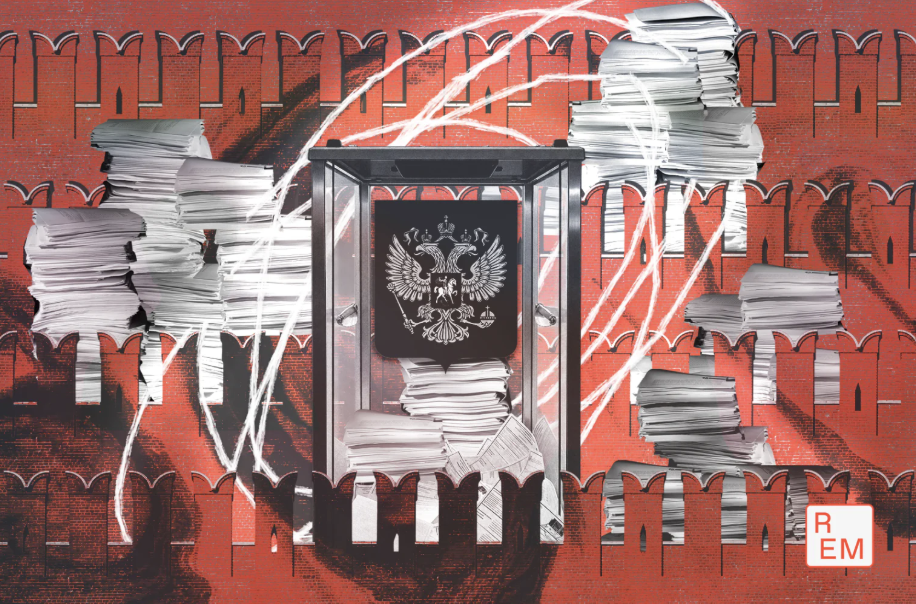
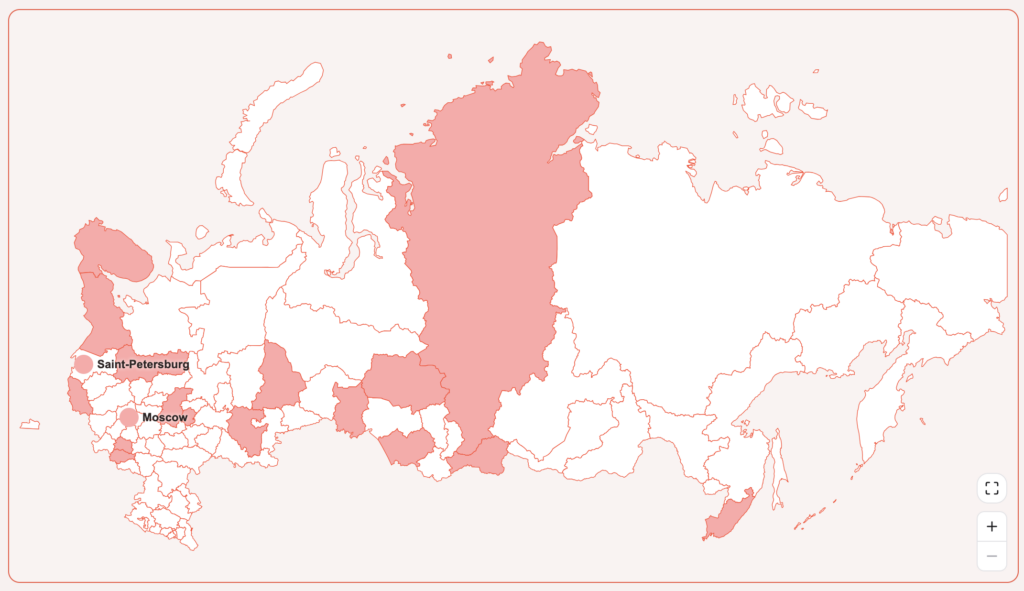
The elections to Russia’s State Duma, held from 18 to 20 September 2026, were the first parliamentary elections since Russia’s full-scale invasion of Ukraine. This year’s so-called “Single Voting Day” took place in a tightly controlled political environment, without genuine competition and turnout managed through unprecedented pressure on voters and manipulations with e-voting, while election commissions in many regions still resorted to ballot fraud. This ranged from straightforward ballot stuffing to more sophisticated “carousel voting” schemes – as the Russian Election Monitor reports.
| READ MORE Russian Election Monitor: Statement on the Russian election 2026 |
In addition to the numerous violations and documented fraud in Russian regions, the Kremlin staged “elections” in the temporarily occupied Ukrainian territories of Crimea, Sevastopol, and parts of Luhansk, Donetsk, Zaporizhzhia, and Kherson regions, in violation of international humanitarian law and of Ukraine’s sovereignty. The occupied population is not a Russian electorate; it is a population held under military occupation that is enforced by widespread and systematic human rights abuses. The illegal organisation of “elections” in these territories was condemned by international institutions, human rights groups and the EPDE.
As in previous elections, authorities and local commissions systematically limited observers’ access, restricted their line of sight, or removed them from polling stations using police and court orders.
The election took place without independent, organized election oversight following the forced dissolution of the Golos Movement and imprisonment of its co-chair, Gregory Melkonyants. Credible international organisations such as the OSCE/ODIHR were not invited to observe.
Instead, Russia has created its own new order of a fake electoral observation ecosystem. EPDE identified and documented an initial group of 36 Fake Observers* whom Russian state propaganda portrayed as international election observers and experts during this year’s State Duma elections. These individuals publicly praised the process while voting was still underway. Without any credible domestic or international election observers present in the country, their presence and comments were presented as independent assessments of the elections without sufficient evidence to support any broad conclusions.
| READ MORE EPDE: What is Fake Observation |
EPDE collected these preliminary findings based on Open Source Intelligence (OSINT) research. This initial list is incomplete, as the Russian Central Election Commission announced over 1,100 international “observers” present. EPDE’s initial findings suggest that the shift toward recruiting foreign “observers” from the Global South continues, with relatively few Western politicians identified so far. Many young participants appear to have been recruited from the International Festival of Youth held in Ekaterinburg the preceding week. IPA-CIS (The Interparliamentary Assembly of Member Nations of the Commonwealth of Independent States) also appears to have begun recruiting young observers from the Global South, including from Haiti, Mali, and Tunisia, a new development in the organization’s approach.
Russian media quoted Štefan Harabin, Slovakia’s former justice minister, as saying:
“I can only say that people came as free individuals, without pressure, without political agitation. Everything is going well, without any problems. I’m surprised by their initiative.”(Quote)
In 2025, Harabin was tried for having supported the Russian invasion of Ukraine.
In the Nizhny Novgorod region, Gonzalo Martin Garcia of Spain’s Democracia Nacional party was quoted on September 19 as saying:
“I came from Spain, and I was extremely interested to see for myself that everything was working as it should. In my opinion, Russia doesn’t need any ‘lessons in democracy’ from outside. As for the procedure itself, as far as I can tell, it’s even more democratic in Russia. Our systems are similar in some ways — for example, in maintaining the secrecy of the ballot — but in Russia, the process seems more open. The system is completely transparent. Even the ballot boxes themselves, where the ballots are dropped, are transparent, and that’s very symbolic. Everything looks superbly organized. From what I saw, everything works perfectly and is extremely open.” (Quote)
This broad political endorsement went well beyond an account of voting conditions at the few polling stations he visited.
Election management body representatives also made statements and claims about electoral integrity. EPDE documented endorsements by foreign election officials already in Russia’s Regional Elections in 2024.
“Voting is conducted in an organized manner, and the most interesting thing is that people can vote physically, using electronic voting devices, and even with their mobile phones” (Quote)
said Pakistan’s Chief Election Commissioner, Sultan Mohammad Jalal Sikandar.
“Our conclusion is based, in part, on our visit to a polling station here today. Digitalization and information technology are highly advanced, and the electronic voting and vote counting systems, along with all of this, serve as guarantees of the integrity of the process. The computerized technological system itself is a tool against any fraud.The overall impression we have is that this is a process whose integrity cannot be questioned. This integrity is primarily ensured by the technology that underpins this process,” (Quote)
said Brahima Fomba, the rapporteur of Mali’s Independent Electoral Management Authority.
On 20 September, Radio 1 quoted a representative of Madagascar’s Independent National Electoral Commission, Adriatsimiala Lanzaniuni Khobi Sariaka, saying that observation centers ensured transparent and fair elections. Statements were reported while voting was still underway.
EPDE also recorded return appearances by participants previously documented by our research, including Marco Marsili, Goran Petronijević (former defender of Slobodan Milosević in the International Tribunal in The Hague), and Goran Šimpraga, the last two observing on behalf of a new organization, IAPEE, reportedly established in Moscow earlier this year.
“The opening of the polling station proceeded smoothly and without violations, with all legally required procedures observed. We see voters already actively turning out to cast their ballots,” (Quote)
said Goran Šimpraga (Serbia), Member of the IAPEE mission; director of Russian Express media center, who is already included in the EPDE fake observers database.
Our research also documents foreign fake observers in Russian-occupied parts of Ukraine. Reports from Luhansk identified Mexican journalist Nydia Egremy and Chilean participant Pablo Sepúlveda Allende.
“I want to say that I have experience attending similar events – elections – as an observer in other electoral processes in other countries, and I want to note that these are the elections that seemed the most transparent to me.” (Quote) “We came as an international delegation. I’m representing the views of each of us now, and I want to say that for us, being here is a great experience, a lesson. We will closely monitor what’s happening here, and we will transfer this experience to our countries.” (Quote)
said Nidya Egremy (Mexico), Editor of Revista Contralínea, a far-left magazine on international affairs
EPDE is concerned that such visits and endorsements help present Russian-organized “elections” in occupied Ukrainian territory as a normal voting process. EPDE rejects the use of foreign “observation” to lend legitimacy to Russia’s occupation.
EPDE proposes several calls to action to discourage the continued participation of fake observers, to protect the integrity of the institutions they represent in the Russian public, and to hold individuals accountable for undermining democratic processes:
By 21 September, EPDE has identified 36 individuals involved as fake election observers during Russia’s 2026 State Duma elections:
| Name | Country | Affiliations |
| Tigran Kocharyan | Armenia | IAPEE mission; editor-in-chief of AlfaNews |
| Sheikh Tawfique Moyazzemul Haque | Bangladesh | Director, South Asian Institute of Policy and Governance, North South University |
| Salvator Nkeshimana | Burundi | African Union Commission (Principal Officer, East and Southern Africa Regional Desk, PAPS) |
| Alejandro Navarro Brain | Chile | IAPEE mission; former member of the Senate of Chile |
| Pablo Sepúlveda Allende | Chile | None listed |
| Crispin Kabasele Tshimanga Babanya Kabudi | DR Congo | President of Union of Socialist Democrats (UDS); co-founder of Crimea-Africa Council; International Russophile Movement |
| Salib Michael Emad Helmy Abdelmalak | Egypt | N/A |
| Ana Lisseth Arias Hernandez | El Salvador | Vice-president of PARLACEN |
| Thaddeus Kosinski | Haiti | IPA-CIS mission; student at Belgorod Technological University |
| Khanak Upadhyay | India (Gujarat) | INDGenius Gujarat; BRICS Student Commission (deputy secretary general from 2024-12) |
| Fauzan al-Rashid | Indonesia | Editor-in-chief, Russia Beyond the Headlines (Indonesian version); included in EPDE database |
| Lanjaniony Sariaka Andriatsimiala | Madagascar | Vice-president, Independent National Electoral Commission (CENI) |
| Kelvin Yii Lee Wuen | Malaysia | MP, Democratic Action Party (DAP); chairman of Russia-Malaysia Interparliamentary Friendship Group |
| Dramane Sow | Mali | IPA-CIS mission |
| Brahima Fomba | Mali | Rapporteur, Independent Electoral Management Authority (AIGE); professor at Bamako University |
| Mohamed Abdellahi Siyam | Mauritania | Vice-president, Economic, Social and Environmental Council |
| Moctar Salem Mohamed Kouneine | Mauritania | Member, Economic, Social and Environmental Council |
| Nidya Egremy | Mexico | Editor of Revista Contralínea |
| Dario Abdulah Camal | Mozambique | IAPEE mission; Youth Council of the African Union Commission; African Youth for Development Commission (AYDEC) |
| Nuaman Ishfaq Mughal | Pakistan / USA | Parliament Times (Washington D.C. correspondent) |
| Amado Cerrud Acevedo | Panama | Partido Revolucionario Democrático (PRD); former President of PARLACEN (2022–2023) |
| Manuel Pires da Rocha | Portugal | Communist Party of Portugal; Coimbra municipal council (as of 2023-09) |
| Marco Marsili | Portugal / Italy | Italian researcher working in Portugal; included in EPDE database |
| Danica Stanisavljević | Serbia | SNS (Serbian Progressive Party); Government Advisor to Aleksandar Vučić; Head of the Foundation “Sveta Petka” |
| Goran Petronijević | Serbia | IAPEE mission; attorney; founder of Russian Express; included in EPDE database |
| Goran Šimpraga | Serbia | IAPEE mission; director of Russian Express; included in EPDE database |
| Štefan Harabin | Slovakia | IAPEE mission; former president of the Supreme Court (1998–2003, 2009–2014); former Minister of Justice (2006–2009) |
| Hyungsik Yun | South Korea | IAPEE (board member) |
| Gonzalo Martin Garcia | Spain | Vice-president of Democracia Nacional; board member of Alliance for Peace and Freedom (APF) |
| Abdullah Ali Hassan Mwinyi | Tanzania | Member of Parliament |
| Fatma Zaibi | Tunisia | IPA-CIS mission; student at Belgorod Technological University |
| Ali Zaghdoud | Tunisia | MP; party La Victoire au Peuple |
| Aydin Mametsahedov | Turkmenistan | IPA-CIS mission |
| Patricia Kishemeire | Uganda | IAPEE (board member); BRICS International Forum representative for Uganda |
| Vladislav Spektorov (Steven Samarin) | USA | Invited by the Civic Chamber of the Russian Federation |
| Stephen Baskerville | USA / Poland | Collegium Intermarium, Warsaw (until 2024); formerly Patrick Henry College; International Institute for Religious Freedom |
*EPDE’s preliminary findings point to two problems: endorsements on the conduct and the outcome of the elections were issued before the voting process could be fully assessed, and some participants’ official positions lent their comments added authority. EPDE’s methodology prioritizes impartiality, possible conflicts of interest, and whether conclusions are supported by transparent observation methodologies based on verifiable evidence. Observers should clearly explain the limits of what they can conclude from their work.
Subscribe to our
newsletter
Sign up for our monthly newsletter
and receive the latest EPDE news
Subscribe to our
newsletter
Sign up for our monthly newsletter and receive the latest EPDE news
