
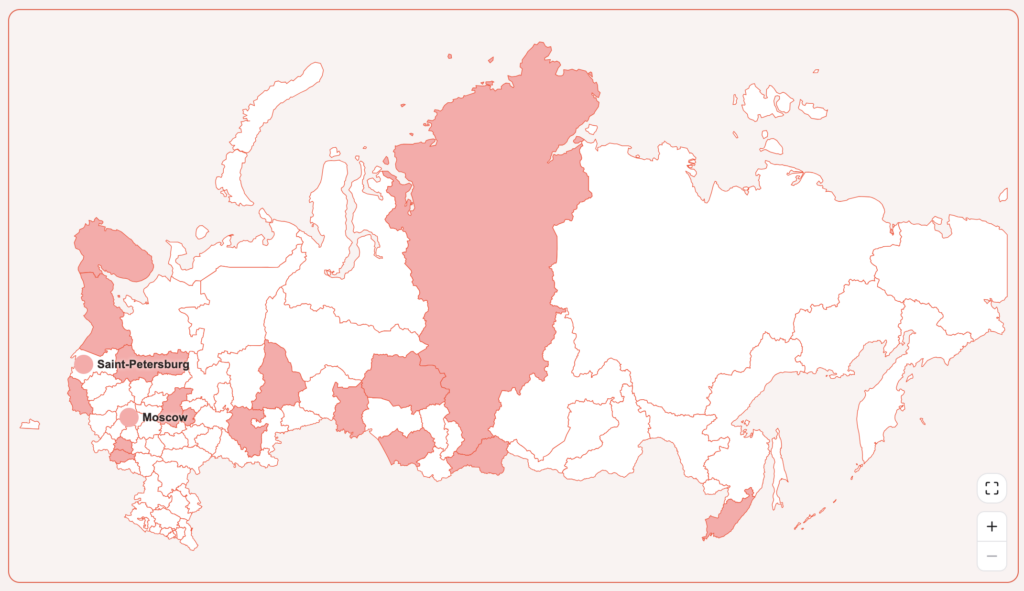
EPDE condemns the Russian Federation’s plan to hold State Duma “elections” between 18 and 20 September 2026 in the temporarily occupied Ukrainian territories of Crimea, Sevastopol, and parts of Luhansk, Donetsk, Zaporizhzhia, and Kherson regions. We call on international institutions and media not to describe, cover, or treat this exercise as a genuine electoral process. It is a tool of occupation, propaganda, and part of Russia’s war against Ukraine. Reporting on “elections” in occupied territories in the language of democratic elections lends it a legitimacy it does not have and must not receive.
“There is no election happening in occupied Ukraine this September. This is an aggressive power staging a performance for its own propaganda apparatus, using an occupied population as props. We are asking our colleagues in the press and in international institutions to name it accurately: this is not an exercise of voting, and no credible institution should lend it the vocabulary of democracy.” – Stefanie Schiffer, Chair of the Board of the EPDE
An occupying power holding “elections” in territory it has seized by force is a violation of international humanitarian law and of Ukraine’s sovereignty. The occupied population is not a Russian electorate; it is a population held under military occupation that is enforced by widespread and systematic human rights abuses.
The pre-election environment inside Russia itself already fails to meet even the most basic democratic standards: banned political opposition, criminalized dissent, state-controlled media, and no independent election oversight left following the forced dissolution of the Golos Movement and imprisonment of its co-chair, Gregory Melkonyants. Extending this contempt for democratic suffrage into occupied Ukrainian territory, under military administration and active war, does not create a “regional” election. It just further undermines a process already stripped of the last remaining preconditions for any credible vote.
Russian occupation authorities are not attempting to hold credible “elections” in these territories, but to stage one. Ukraine’s Center for Countering Disinformation reports that the Kremlin has set explicit turnout and vote-share targets for the occupied regions — publicly cited figures of over 65–70% turnout and at least 70% support for the ruling United Russia party as Russia seeks inflated turnout figures and guaranteed results to legitimize the occupation and increase social control. To engineer this outcome, Russia has sent in officials from the Russian Federation rather than relying on local collaborators to deliver the desired result. Additionally, Russia will likely activate its loyal structure of international pro-Kremlin experts, journalists, and politicians to “observe” the “vote”.
This is not new. Russia has a documented track record of deploying so-called “fake observers” to whitewash sham elections, and it has since institutionalized the practice: a dedicated Kremlin-linked infrastructure now exists specifically to manufacture the appearance of independent election observation, domestically and internationally. We expect this apparatus to be mobilized again around the September 2026 vote.
It is clear that the organizers of the current elections have designed them primarily as a demonstration that the political status quo remains intact despite the dramatic challenges confronting the system.
The carefully constructed appearance of electoral normality can apparently be disrupted — and a measure of political uncertainty introduced — only by regional and local elections, which remain subject to somewhat less comprehensive control.
We urge journalists and international institutions: do not use electoral vocabulary (“voting,” “polling,” “elections,” “turnout,” “results”) to describe what is happening in occupied Ukrainian territory, except in quotation marks and with explicit context.
Framing this as an electoral event, even a flawed or disputed one, obscures what it actually is: an instrument of forced integration, social control, and a component of Russia’s war against Ukraine.
—
The Russian Election Monitor (REM), a strategic partner of the EPDE, provides regular analyses on the context and environment of electoral matters in the Russian Federation. Latest pieces include:
Subscribe to our
newsletter
Sign up for our monthly newsletter
and receive the latest EPDE news
Subscribe to our
newsletter
Sign up for our monthly newsletter and receive the latest EPDE news
