
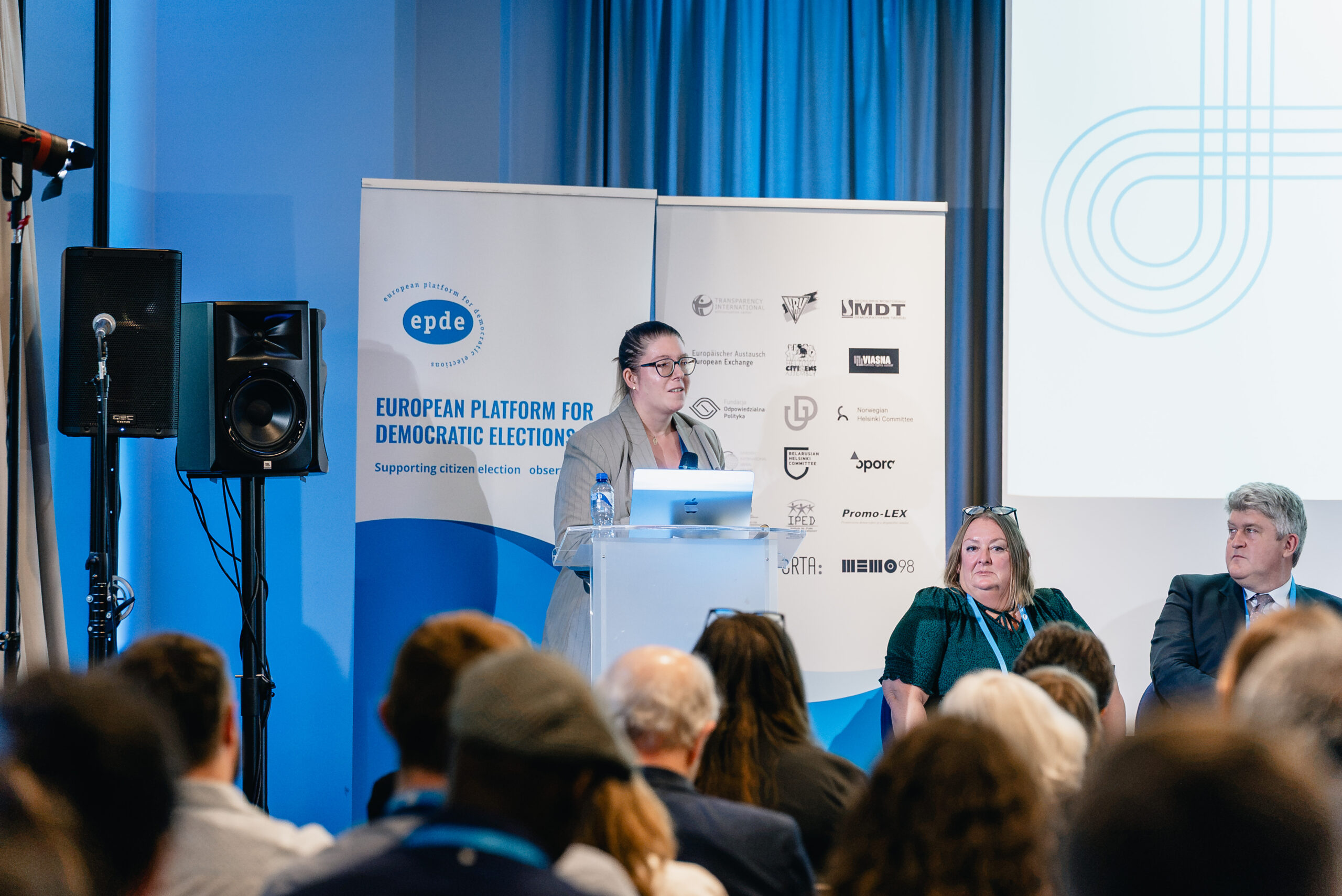

Zosia Lutkiewicz, President of the Political Accountability Foundation and EPDE board member, delivered closing remarks at the FURIC2026, which took place on 30 September – 1 October 2026 in Brussels.
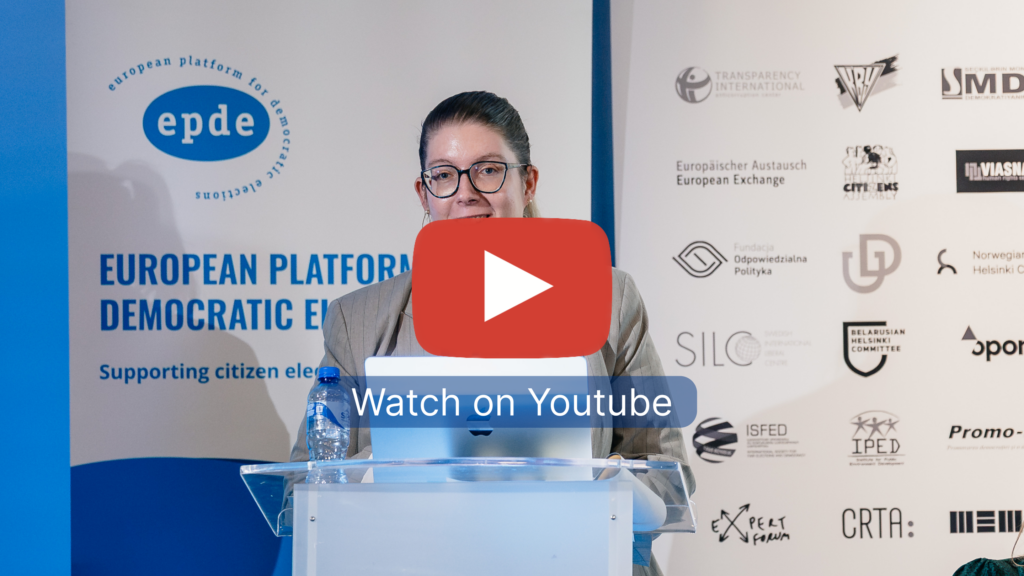
“First, perhaps the most obvious conclusion from these two days: elections have become considerably more complicated, and our job has not become any easier. We have talked about FIMI, DIMI, AI, third-party campaigning, cybersecurity, fake observers, shrinking civic space, data protection, electoral technologies and — occasionally — the actual casting and counting of ballots.
There is a temptation, when the list becomes this long, to conclude that we simply need ever more sophisticated methodologies to chase every new threat. We probably do. But we should also be careful not to become so fascinated by the new threats that we forget the old vulnerabilities. Vardine [Grigoryan, Program Manager at Helsinki Citizens’ Assembly – Vanadzor] said yesterday that while everyone is looking online, quite a lot is still happening on the ground. And Dana [Munteanu, Secretary of the Central Electoral Commission (CEC), Republic of Moldova] reminded us that malicious activity also needs money.
Technology changes. Political incentives are remarkably persistent.
So perhaps future-proofing elections is not about predicting every tool that will exist five years from now. It is about building institutions, safeguards, and civic actors strong enough to deal with the tool we failed to predict.
Second, observation is not something that happens to an election. It is part of the democratic infrastructure around it.
Citizen and international observers have complementary roles. But citizen observers provide something international missions cannot replicate: continuity, local knowledge, memory, and trust. We know what happened three elections ago. We know which recommendation has been sitting untouched for a decade. We know whether a provision that looks perfectly respectable on paper actually works in practice.
And that became particularly tangible for me very recently in Kazakhstan. A number of genuine citizen observers I met there were not observing these elections themselves — because they feared retaliation. But they were still extraordinarily important to us as international observers. They helped us understand the context, helped gather information, and people brought information to them because people trusted them. That trust cannot be deployed six weeks ahead of an election. It is built over years.
This also brings me back to yesterday’s discussion about when international missions are deployed — and when they are not. In light of the United States deciding not to invite ODIHR to its midterm elections — joining Russia and Belarus in failing to issue an invitation — I think this is something we all condemn. But we also heard that a country should have an election that “deserves” to be observed. I think we need to be very careful with that logic. An observation mission should not be a reward. Observation is scrutiny.
Of course, there are situations in which meaningful observation is impossible. But the presence or absence of an international mission should not become a diplomatic seal of approval. Whatever decision an international organisation makes, the electoral process — and the need for scrutiny — does not disappear. Domestic observers prove this again and again, including in the most restrictive contexts.
Now, there is also a reason we should all pat ourselves on the back. Nothing demonstrates the authority election observation has acquired quite like the effort being put into imitating it — internationally and domestically.
Those seeking to undermine democratic scrutiny have learned our vocabulary. They talk about transparency. They talk about standards and methodologies. They create organisations that look remarkably like ours. Political actors increasingly discover that they too can deploy supposedly “non-partisan” observers. So simply saying we are the genuine observers is not enough.
Our defence has to be the quality of what we do: transparent methodology, evidence, political independence, professional standards and openness to scrutiny. And this is where networks such as EPDE, AfEONet and, of course, GNDEM have a particular responsibility.
And that brings me to my next point: protection of election observation has to mean protecting more than election observers. Yesterday and today we asked how we better defend those who defend democracy. Of course, this means people: their physical safety, legal protection, freedom from intimidation, and ability to operate. But it also means protecting organisations. Protecting findings and the ability to communicate them. And ultimately protecting the public’s right to receive independent information about how its elections are conducted.
And we need to get considerably better at explaining all of this. Communication has come up again and again over these two days. We spend enormous amounts of time developing methodologies, documenting findings and drafting recommendations. But we are sometimes rather less good at explaining why any of it matters. A recommendation that says ‘the legal framework should be reviewed’ may make perfect sense to everyone in this room. But we need to communicate not only what we recommend, but what non-implementation means.
And the same is true for observation itself. We need to explain what observers can establish. What they cannot establish. Why methodology matters. Why one incident does not automatically invalidate an election — and why a pattern sometimes matters much more than one dramatic incident.
This matters especially when fake observers are often much better than we are at producing a simple, confident message: everything was great. Evidence-based observation will always be more complicated than propaganda, but the way we talk about election observation also shapes who feels that they belong in this space.
So on that note, it is great to see Agora, Polaris, Silba and EDDA in the room. We really learn a lot from you. I hope this doesn’t count as youthwashing.
But let me go back to recommendations for a second – recommendations are by far not the finish line. Nicolae [Panfil, Program Director, Promo-LEX Association] put this very clearly today: what comes after the report may matter more than the report itself.The preliminary DIVE findings presented today gave us a slightly sobering indication of why we still have work to do: of more than 900 recommendations mapped across eight European countries, only 39 were fully implemented.
This reinforces something we already know. Writing the recommendation is only the beginning. Recommendations matter when civil society keeps asking about them, EMBs use them, parliamentarians are willing to act, and international institutions keep raising them. And when we are ready with solutions at the moment political momentum finally appears.
FURIC is particularly useful because it brings together the people who make recommendations, the people expected to implement them, and the people who monitor whether anything happened afterwards.
And that is part of the FURIC magic.
But there is another thing that makes FURIC special. We are sitting here in Brussels, in the institutional heart of the European Union. But over these two days, the examples have moved constantly between the EU, its neighbourhood, Africa, and the wider world.
Whatever names we give each other — Global South, established democracies, candidate countries, international or citizen observers, EMB representatives, technical assistance providers — we can all learn from each other. And that kind of genuine exchange is part of that FURIC magic.
Which brings me to perhaps the biggest takeaway: resilience is relational. One word kept returning throughout these two days: cooperation. And yes, that can sound slightly fluffy in a conference conclusion — until you remember that we are increasingly operating in crisis mode.
Very often resilience comes down to whether somebody picks up the phone. Whether colleagues in another country have seen the same tactic before and can say: we recognise this; here is what happened to us; here is what worked; here is what absolutely did not. Whether the international community already knows and trusts citizen observers before a crisis — like in Zambia.
FURIC is not only a place where we discuss recommendations. It is a place where this community comes together and enjoys the discussions in the panels — but perhaps even more so during the coffee breaks. And both were excellent.
And that brings me to the people who are not in this room. FURIC is a place where we meet — and where, year after year, we notice who is here and who cannot be. It is genuinely wonderful to have Valiantsin from Viasna back with us.
And I hope very much that when we meet again, Anar, Grisha, and Sarah will be here too. Until then, one of our greatest responsibilities is very simple: keep saying their names and keep telling their stories.
We have spent two days talking about how to future-proof democratic elections. How to design international solutions to international problems. Hopefully you leave this place with your brains full of ideas and your hearts full from sharing this space with friends and partners.
In one of the breakout sessions today, Ulvi [Akhundlu, Deputy Head of the Election Department of the OSCE/ODIHR] said he is a FURICoholic: a person who has an unhealthy fixation on seeing electoral recommendations actually implemented.
So to you I say: my name is Zosia, I’m a FURICoholic. Thank you for being part of this community, and see you next year!“
