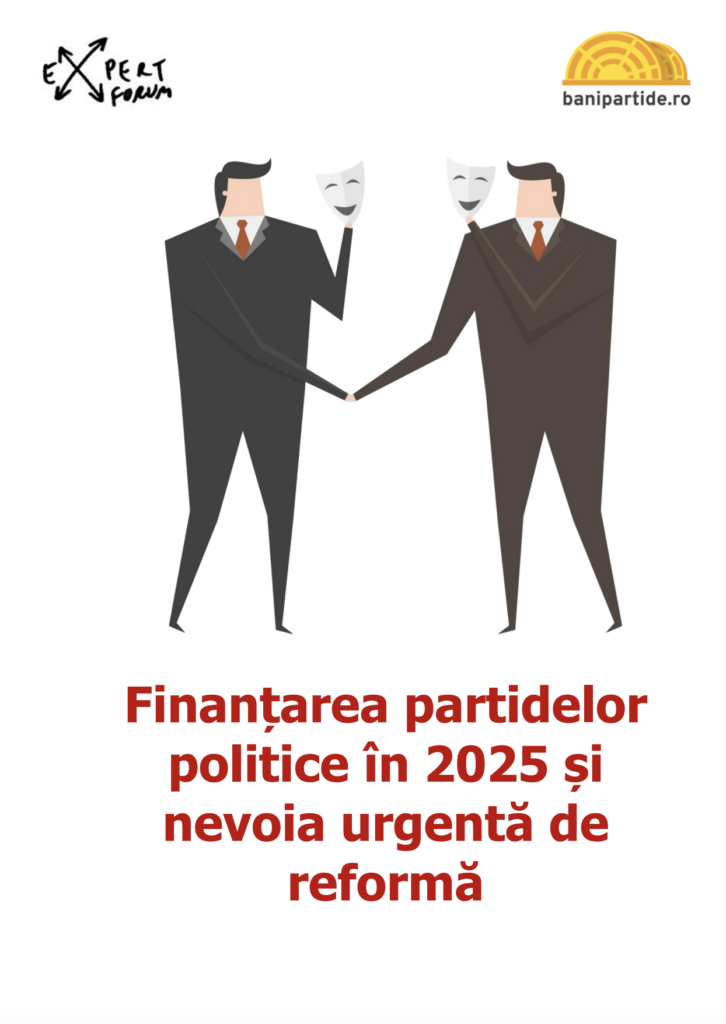
Romania | Political Party Financing in 2025 and the Urgent Need for Reform

  • A recent report by EPDE member Expert Forum (EFOR) analyzes political party financing in 2025, against the backdrop of the Permanent Electoral Authority’s announcement of a broader reform of legislation governing political parties, election campaigns, and the institution’s operations. Although 2025 did not reach the exceptional level of 2024, when campaign reimbursements and subsidies exceeded one billion lei, revenues remained high compared to previous years, totaling 323 million lei for parties and 381 million lei for national minority organizations. The report does not aim to analyze campaign contributions in detail, as these are addressed separately in monitoring reports during campaigns; however, it emphasizes that regular and campaign financing cannot be completely separated, since parties use a significant portion of the funds obtained for party activities for activities with electoral impact.
  • The financing of political parties in Romania remains dominated by subsidies (including massive campaign reimbursements) and loans—one of the major changes over the past two election cycles. The lines between party financing and campaign financing are blurred. Some of the main problems remain the high level of subsidies and unclear mechanisms for allocating funds, the lack of overall limits for donors, the opacity of funding sources—especially in campaigns—and inconsistent reporting.
  • The lack of resources at the Permanent Electoral Authority (AEP) limits its oversight capacity. The authorities’ limited ability to effectively verify the origin of funds, including through inter-institutional collaboration, limits the transparency of the process. Furthermore, collaboration with institutions such as the National Audiovisual Council (CNA) remains limited, which could provide a more robust picture of how funds are spent on media and propaganda. A reform should eliminate political influence and strengthen the independence of oversight actions. Sanctions remain limited and are not dissuasive. Funding for political parties appears to be less ideological and more focused on securing political influence. The fact that Social Democrat Party (PSD) donors contributed to the Alliance for the Union of Romanians party’s (AUR) revenues in 2025 or that National Liberal Party (PNL) members donated to the PSD supports this conclusion. As in previous years, we identified possible cases of donors whose donations or loans do not match the data in their asset declarations or the financial information reported to the Ministry of Finance.
  • A reform of political financing should reduce the risks of buying political influence, limit the concentration of resources within narrow networks, and ensure a better balance between public funding, genuine political competition, and transparency toward voters. It should be noted that, following the cancellation of the 2024 elections, policymakers have not taken any significant measures to improve the legal framework on political financing that would limit the emergence of major risks to the integrity of the electoral process in the future. Nor has the legislation on declarations of assets and interests been amended, which means that we will likely no longer be able to conduct such analyses in the coming years.

An English long summary of the report is available on the website of Expert Forum (EFOR).

(May 26, 2026)
Romania

Subscribe to our
newsletter

Sign up for our monthly newsletter
and receive the latest EPDE news

Subscribe to our
newsletter

Sign up for our monthly newsletter and receive the latest EPDE news

We use cookies to optimize our website and our service. Manage your cookie settings here.