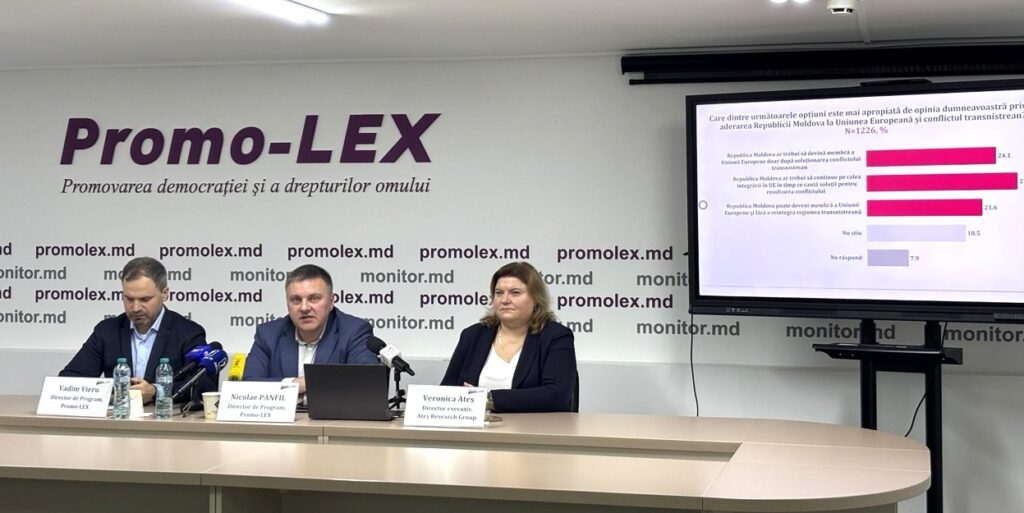
This study by the Promo-LEX Association provides a broad picture of electoral processes, the functioning of democratic institutions and respect for human rights, including in the Transnistrian region.
The results of the study reveal that citizens’ interest in socio-political life is variable: 33.9% of respondents declare themselves quite interested, and 19.9% very interested, while 23.1% are not very interested and 8.6% not at all interested. Another 20.9% have a neutral position. At the same time, perceptions regarding the direction of the country’s development and the ability of citizens to influence public decisions remain divided, with a significant part considering that their influence is limited. About 90% of respondents claim that they had the opportunity to choose freely, which indicates a generally positive perception of the electoral process.
For future elections, citizens believe that more measures should be taken to ensure their fairness. Specifically: combating voter corruption (47.9%), protecting elections from foreign influences (34.4%), and combating disinformation in electoral campaigns (33.7%).
Perceptions regarding the free and fair nature of the elections are divided (almost 43% — to a very large extent/to a large extent, and over 51% — to a small extent/to a very small extent), and the data show that a significant number of respondents (59.9%) believe that there were at least some irregularities or violations of electoral legislation. These are perceived to have occurred both at the national level and in the polling stations in the diaspora. Respondents also assessed differently the way in which the authorities handled these situations.
At the same time, most respondents are aware of election monitoring by non-governmental organizations and believe that it contributes to reducing violations and increasing the transparency of the electoral process.
The sociological study data also shows that, in the parliamentary elections of September 28, 2025, 24.3% of respondents declare that they did not vote, and over 75% did. Among the reasons for non-participation are lack of interest (19.3%), distrust in politicians/parties (12.9%), electoral apathy (10.1%) and other personal circumstances, including reasons such as work schedule (1.4%), religious reasons (1.3%) or family responsibilities (0.9%).
Mass media and social networks were important sources of information during the electoral campaign. “The results show that social networks are one of the main sources of information: 37% of respondents use them often, and 18% – very often. At the same time, 25% do not use them at all, and approximately 20% – rarely. Television remains, however, an important source of information. Approximately 45% of respondents stated that they get information often or very often from television. However, approximately 25–26% mentioned that they do not get information from this source at all, and others use it rarely. In the case of news sites, the use is more fragmented: 33% of respondents do not use them at all, 25% access them rarely, while 30% use them often and 18% very often”, mentioned Veronica Ateș, Executive Director, Ateș Research Group.
Regarding human rights in the Transnistrian region, the collected responses indicate predominantly negative or moderate perceptions regarding their respect (62.3% — not at all/to a small extent/to some extent). Approximately half of the respondents believe that the authorities of the Republic of Moldova do not make sufficient efforts to protect the rights of people in the region. At the same time, responsibility is attributed to several actors, including the constitutional authorities (31.2%) and the de facto administration in Tiraspol (33.7%).
“The citizens of the Republic of Moldova are sending a clear message: the settlement process must begin with respect for human rights and the withdrawal of foreign military forces. These are the two pillars on which society wants any solution to be built. Half of the population of the Republic of Moldova believes that the Government is not doing enough to protect the rights of citizens on the left bank of the Nistru River. This is a matter of credibility and concrete action. Citizens demand more – not just declarations, but visible results,” said Vadim Vieru, Program Director (Human Rights), Promo-LEX.
Perceptions of governance indicate a variable level of trust in institutions. The top three institutions in which citizens trust are: the church (52.5%), the local government (46.2%), and the Presidency (34.1%). At the opposite end are political parties, the prosecutor’s office, and the courts. Non-governmental organizations are in the middle of the list of citizens’ trust (24.3%). The data also show that interest in the work of the Parliament is moderate, and a significant part of the respondents consider that the topics discussed in the Parliament are only slightly or not at all close to the real problems of citizens (66.8%). Also, the assessment of the relationship between the parliamentary majority and the opposition indicates critical perceptions regarding the level of cooperation and political dialogue.
Regarding priorities for the coming years, respondents specifically indicated: increasing salaries and pensions (72.1%), developing the economy (61.4%), and combating corruption (56.1%). Resolving the Transnistrian conflict, integration into the European Union, and administrative-territorial reform are at the bottom of the ranking, which shows the need for broader communication of the reforms and government priorities regarding them.
The presentation of the results of the sociological study can be accessed in Romanian and English.
The sociological study “Citizens’ Perceptions on the Quality of Elections and the Functioning of Democratic Processes in the Republic of Moldova” is developed within the project “Democracy in Action: Strengthening Electoral Integrity, Political Accountability and Civic Participation”, implemented by the Promo-LEX Association, with the support of the Government of the United Kingdom of Great Britain and Northern Ireland and Sweden.
Subscribe to our
newsletter
Sign up for our monthly newsletter
and receive the latest EPDE news
Subscribe to our
newsletter
Sign up for our monthly newsletter and receive the latest EPDE news