
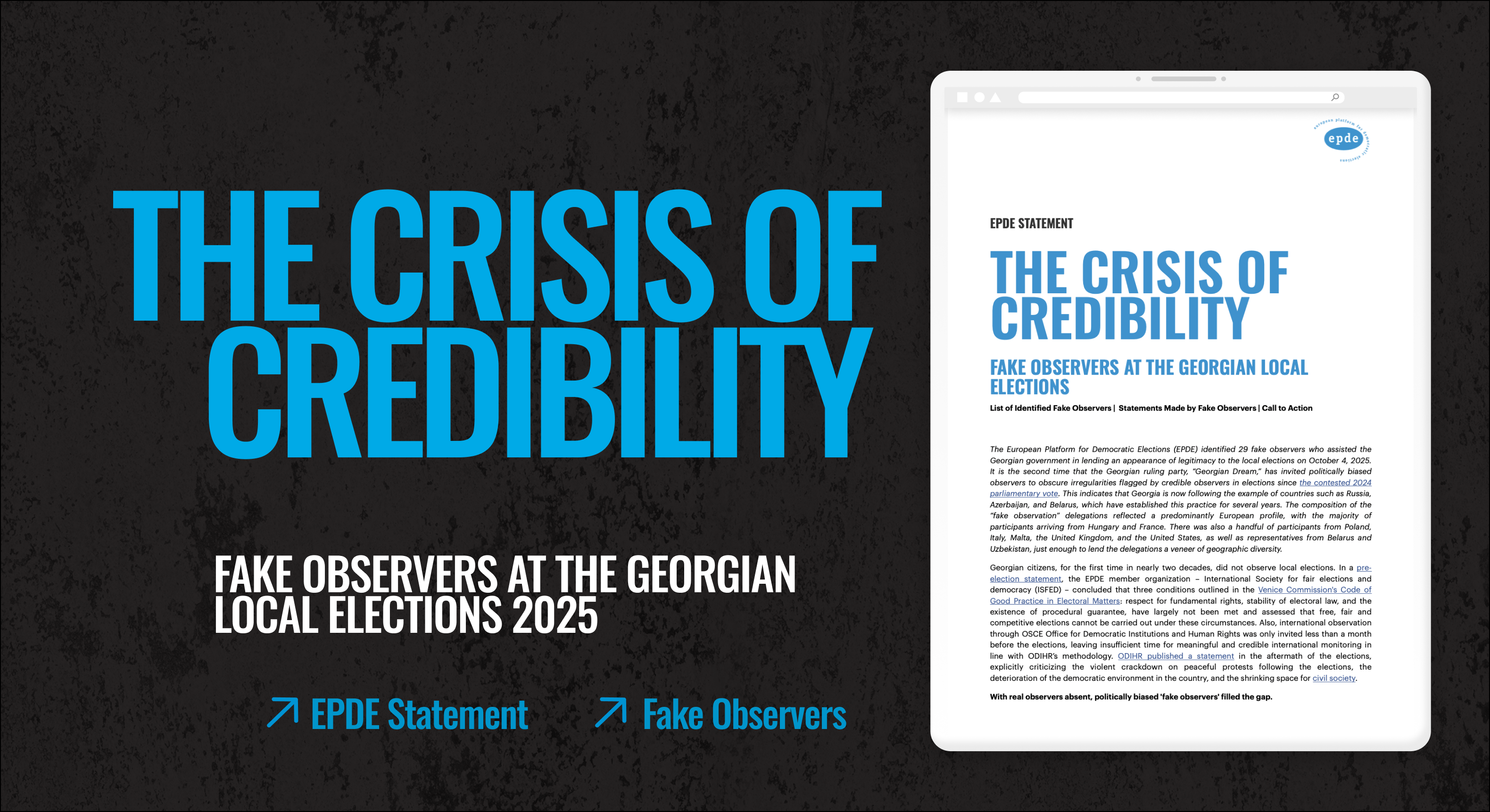

The European Platform for Democratic Elections (EPDE) identified 29 fake observers who assisted the Georgian government in lending an appearance of legitimacy to the local elections on October 4, 2025. It is the second time that the Georgian ruling party, “Georgian Dream,” has invited politically biased observers to obscure irregularities flagged by credible observers in elections since the contested 2024 parliamentary vote. This indicates that Georgia is now following the example of countries such as Russia, Azerbaijan, and Belarus, which have established this practice for several years. The composition of the “fake observation” delegations reflected a predominantly European profile, with the majority of participants arriving from Hungary and France. There was also a handful of participants from Poland, Italy, Malta, the United Kingdom, and the United States, as well as representatives from Belarus and Uzbekistan, just enough to lend the delegations a veneer of geographic diversity.
Georgian citizens, for the first time in nearly two decades, did not observe local elections. In a pre-election statement, the EPDE member organization – International Society for fair elections and democracy (ISFED) – concluded that three conditions outlined in the Venice Commission’s Code of Good Practice in Electoral Matters: respect for fundamental rights, stability of electoral law, and the existence of procedural guarantee, have largely not been met and assessed that free, fair and competitive elections cannot be carried out under these circumstances. Also, international observation through OSCE Office for Democratic Institutions and Human Rights was only invited less than a month before the elections, leaving insufficient time for meaningful and credible international monitoring in line with ODIHR’s methodology. ODIHR published a statement in the aftermath of the elections, explicitly criticizing the violent crackdown on peaceful protests following the elections, the deterioration of the democratic environment in the country, and the shrinking space for civil society.
With real observers absent, politically biased ‘fake observers’ filled the gap.
By October 9, EPDE has identified 29 individuals involved as fake election observers during the Georgian municipal elections 2025:
| Country of Residence | Name | Affiliation |
| Albania | Erton Sinani | Chief of Staff at the Central Election Commission of Albania |
| Belarus | Elena Baldovskaya | Deputy Head, Central Election Commission of Belarus |
| Belarus | Ekaterina Fedosenko | Representative of the Central Election Commission of Belarus |
| Bosnia and Herzegovina | Vanja Bjelica-Prutina | Member of the Central Election Commission of Bosnia and Herzegovina* |
| France | François-Xavier Gicquel | Director of operations at SOS Chrétiens d’Orient (SOSCO) |
| France | Marc Gairin | Mayor of Momy, Rassemblement National party |
| France | Benoist François Marie (media alias) | Not identified |
| France | Franck Pengam | Founder, Géopolitique Profonde |
| France | Alain Avril | Entrepreneur |
| France | Louis Clément Marie (media alias) | Not identified |
| France | Matthieu Buronfosse | Association “ALTERFACT”, Director of Business Development and Loyalty Dupont Restauration SAS |
| Hungary | András László | Member of the European Parliament, Patriots for Europe Group, Fidesz party |
| Hungary | Barbara Szilvia Hegedűs | Member of the National Assembly of Hungary, Fidesz party |
| Hungary | Norbert Révai-Bere | Foreign policy adviser to the National Assembly of Hungary, former Consul General of Hungary in India |
| Hungary | Fanni Lajkó | Analyst at the Center for Fundamental Rights (CFR) |
| Hungary | Juan Efraín Rocha | Former Government Official in the Department for Nationalities of the Prime Minister’s Office, Hungary |
| Hungary | István Németh Laszlo | President of the Western Transdanubian Organization of the Recski Association |
| Italy | Marco Malaguti | Fellow researcher, Machiavelli Center |
| Latvia | Reinis Tocelovskis | Co-Founder Digiroadshow.com, Co-Founder & CEO of My3D.Cloud |
| Malta | Justine Gaspar | Democratic Pluralism Research Center, Owner and Director of Life Learning Academia Malta |
| Netherlands | Alexander Rakov | Regional Development Director, Smartmatic – The Elections Company |
| Poland | Ryszard Henryk Czarnecki | Former MEP, Prawo i Sprawiedliwość (PiS) party |
| Poland | Patryk Ignaszczak | Analyst in the Center of International Law, The Ordo Iuris Institute for Legal Culture |
| Slovakia | Alexander Trstenský | The Department of Elections, Referendum and the Political, Parties of the Ministry of Interior of the Slovak Republic |
| Spain | Luke Uribe-Etxebarria Apalategi | Member of the Basque Parliament, Basque National Party (EAJ-PNV) |
| United Kingdom | Alaa Garad | Democratic Pluralism Research Center, Pro Vice‑Chancellor (Academic), CEO, Dundee Centre of Business Excellence |
| USA | Jake Hoffman | Centre for Fundamental Rights (Hungary), Executive Director of Tampa Bay Young Republicans and Florida Young Republicans |
| USA | Jay Patel | The Centre for Fundamental Rights (Hungary) |
| Uzbekistan | Zayniddin Nizomxoʻjayev | Chairman of the Central Election Commission of the Republic of Uzbekistan |
The “fake observer” statements appear coordinated around a set of political talking points:
In particular, the repeated claims that Western reporting on Georgia is “biased” or “misleading” reflect a broader pattern of disinformation and legitimization strategies observed across the autocracies and fragile democracies in the post-Soviet region.
EPDE’s research identified several groups of observers, some of which fulfilled the requirements of “fake” observers as defined by EPDE’s methodology, distinguished by the method used to obtain accreditation. One cohort comprised individuals accredited under official state umbrellas, registered delegates of foreign election authorities, and others appearing under the auspices of state institutions, such as the Hungarian National Assembly or Slovakia’s Ministry of the Interior. A second group included persons affiliated with marginal think tanks/CSOs or private businesses who were accredited through non-Georgian organizations such as the Center for Fundamental Rights (Hungary) and the ALTERFACT Association (Serbia). A separate anomaly involves three identified individuals wearing non-standard badges with two of whom publicly presented themselves as accredited by the “Democratic Pluralism Research Center,” while the third appeared alongside them at the same press conference; according to the CEC register, that entity was accredited as a local observer organization and issued only a single accreditation to one individual, indicating the use or display of credentials beyond the sole authorization.
“We’ve been to two different cities and, maybe, five or six polling stations. Everything looks good to me from observing; very peaceful outside, no protests, no stopping anybody from voting or anything like that, you have a smooth process here. I said yesterday, I think that maybe you could export some of your practices to some of our states in the United States, like California. I see that you check IDs here, you fingerprint, you get a receipt with a picture on it, and you have a very secure way of making sure people are supposed to be voting. In America, not so much in some of the states. It’s good to have the combination of the electronic system and the paper system to back it up. It makes it easier to count. You’ll have a number much faster at the end of the day, versus trying to count paper ballots. That’s why it’s good to have both. Overall, I think that you are doing a very good job with the election. I think that everything has been very smooth. I think it seems very professional, and I think that it seems very secure from everything that I’ve observed so far at the polling stations we’ve been to.” (Quote)
claimed Jake Hoffman, invited through the Centre for Fundamental Rights (Hungary). Hoffman is an executive director of Tampa Bay Young Republicans and Florida Young Republicans. Hoffman co-founded Invasion Digital Media, a digital marketing company, and “has spent the last four years serving as the President of The Tampa Bay Young Republicans, which has been credited with influencing meaningful legislation in Florida.” He gave a live interview to government-affiliated TV Imedi.
“While observing the parliamentary elections last year, I was convinced that the electoral system is solid and well-functioning, taking into account the relevant regulations. We did not come to this year’s elections with a large observation team; however, we had interesting discussions at the polling stations. How can others, including Georgian observers and ordinary voters, feel satisfied with the electoral system? The technologically sound electronic electoral system was very well received. The fact that the results were announced so quickly is due to this technology.” (Quote at 7:46 minutes)
claimed András László, Hungarian Member of the European Parliament, from Orbán’s Fidesz party. He has already gathered experience as a fake observer at the contested 2024 Georgia parliamentary election.
“We are independent international observers from Hungary. We have been observing throughout the day that the election process reflects the efforts of voters to strengthen local democracy. The elections are very transparent and well-organized. Modern technology is being used. Citizens seem to realize the importance of active participation in the elections. They consider it important to have proper and transparent representation in cities and regions.” (Quote at 1:16 minutes)
claimed Barbara Szilvia Hegedűs, member of the National Assembly of Hungary, from Orban’s Fidesz party.
“I am highly impressed by the confidence of the local electorate. They have full trust in the election process. I asked voters about the pre-election period, and all the responses were positive. Civic education in Georgia is at a high level. About 90% of the election process is electronic, which is also very impressive. People have access to information, and the elections are very well administered.” (Quote at 2:31 minutes)
said Justine Gaspar, Democratic Pluralism Research Center, owner and director of Life Learning Academia (Malta).
“We visited several polling stations, and I can say with confidence that the Central Election Commission of Georgia is fully ensuring the smooth administration of the process. Judging by the faces of the voters, they are happy to take part in these important elections, as local self-government elections represent the future of the Georgian people. It should also be emphasized that the electronic technologies and verification devices are working properly and efficiently, without any flaws. It is clear that voters are well informed about the technology, which means that the Central Election Commission has carried out a timely and successful information campaign.” (Quote at 2:05 minutes):
claimed Erton Sinani, Chief of Staff at the Central Election Commission of Albania.
“The elections are going smoothly and voter turnout is very good. Voters are well informed about new election technologies and I think the Central Election Commission of Georgia has done an excellent job in educating voters. (…) The use of electronic technologies is also being implemented smoothly.” (Quote at 2:46 minutes):
claimed Vanja Bjelica-Prutina, member* of the Central Election Commission of Bosnia and Herzegovina.
“I came from Italy to observe the elections. What I saw was that everything was in order and in line with democratic standards. People had the opportunity to express their views freely and without pressure.” (Quote)
said Marco Malaguti, research fellow at the Machiavelli Center, a right-wing think tank based in Italy, whose mission is to promote traditional values and conservative policies. As a philosophy scholar, Malaguti has been working for years on the topic of reevaluating nihilism and the great German Romantic philosophy.
“I am very surprised by how well-organized the election process is. I am from France, and we don’t have elections organized in this way. You are conducting them almost flawlessly. In the Western media, I always read that horrible things are happening here in Georgia, but the reality is completely different. On the ground, there are three or four political parties represented — you ask them if everything is fine, and you get positive responses. So I have a question: what exactly are the Western media talking about? What kind of flaws are they trying to find here?” (Quote at 4:05 minutes)
said Alain Avril, a French entrepreneur who has also appeared as a fake observer at the contested 2024 Georgia parliamentary election.
Politically biased fake observers and groups do not publish their observation methodologies and lack political and ideological impartiality. The participation of known actors from EPDE’s database, such as András László, Ryszard Czarnecki, Franck Pengam, Alain Avril, and others, further confirms the suspicion of an informal transnational network engaged in what can be described as alternative election observation. The resulting media coverage provides host governments with politically useful endorsements while eroding public confidence in independent election monitoring. This tactic is a key part of information manipulation: replacing real oversight with staged performances that praise fraudulent elections and generate confusion.
EPDE strongly condemns the involvement of politically biased observers to distort international perceptions. We call on the international community to take the following actions:
The discrediting of international election observation through the use of fake observers poses a direct threat to democracy and transparency. EPDE remains committed to exposing such practices and advocating for robust international action to protect the integrity of electoral processes worldwide.
Contact for further information:
Lukasz Kondraciuk
Head of Election Integrity, European Platform for Democratic Elections
kondraciuk@european-exchange.org
info@epde.org
* In a previous version, Ms. Vanja Bjelica-Prutina was incorrectly listed as the President of the Central Election Commission; she is, in fact, a member of the Commission.
Subscribe to our
newsletter
Sign up for our monthly newsletter
and receive the latest EPDE news
Subscribe to our
newsletter
Sign up for our monthly newsletter and receive the latest EPDE news