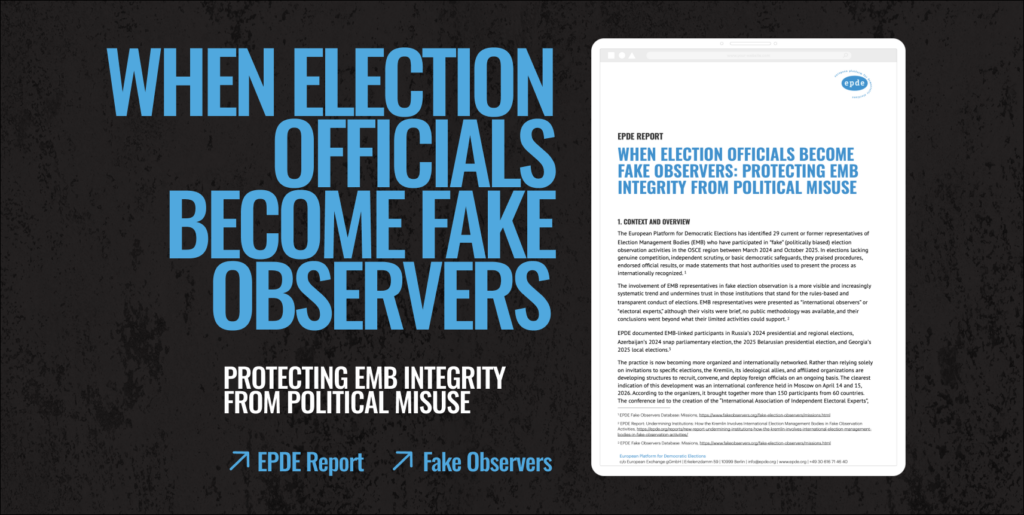
The European Platform for Democratic Elections has identified 29 current or former representatives of Election Management Bodies (EMB) who have participated in “fake” (politically biased) election observation activities in the OSCE region between March 2024 and October 2025. In elections lacking genuine competition, independent scrutiny, or basic democratic safeguards, they praised procedures, endorsed official results, or made statements that host authorities used to present the process as internationally recognized.
The involvement of EMB representatives in fake election observation is a more visible and increasingly systematic trend and undermines trust in those institutions that stand for the rules-based and transparent conduct of elections. EMB representatives were presented as “international observers” or “electoral experts,” although their visits were brief, no public methodology was available, and their conclusions went beyond what their limited activities could support.
EPDE documented EMB-linked participants in Russia’s 2024 presidential and regional elections, Azerbaijan’s 2024 snap parliamentary election, the 2025 Belarusian presidential election, and Georgia’s 2025 local elections.
The practice is now becoming more organized and internationally networked. Rather than relying solely on invitations to specific elections, the Kremlin, its ideological allies, and affiliated organizations are developing structures to recruit, convene, and deploy foreign officials on an ongoing basis. The clearest indication of this development was an international conference held in Moscow on April 14 and 15, 2026. According to the organizers, it brought together more than 150 participants from 60 countries. The conference led to the creation of the “International Association of Independent Electoral Experts”, or the “International Association of Independent Political and Electoral Experts”, abbreviated IAIEE or IAPEE. The Association presents itself as an alternative platform for international electoral expertise. Its stated approach prioritizes state sovereignty, national interests, political traditions, and opposition to alleged foreign interference. Several individuals involved in the Association or its reported leadership have previously participated in fake observation missions, suggesting that the Association may be formalizing networks that previously operated through ad hoc invitations.
This report is based on EPDE’s Fake Observers Database and additional open-source research. The accompanying list includes individuals with a documented current or former link to an EMB who meet EPDE’s methodology for identifying fake observers. Even without a formal mandate, host authorities and state-aligned media may use the individual’s title and affiliation to create the impression that a foreign electoral institution has endorsed the election. Inclusion on EPDE’s list does not, by itself, show that the relevant institution approved the visit or endorsed the individual’s statements. When authorization, financing, or the capacity in which a person participated cannot be established, this is treated as a limitation of the available evidence.
Professional cooperation among EMBs can strengthen electoral administration. However, in the absence of clear rules on authorization, transparency, and accountability, the same networks can confer systemic credibility on elections that do not meet democratic standards.
Subscribe to our
newsletter
Sign up for our monthly newsletter
and receive the latest EPDE news
Subscribe to our
newsletter
Sign up for our monthly newsletter and receive the latest EPDE news