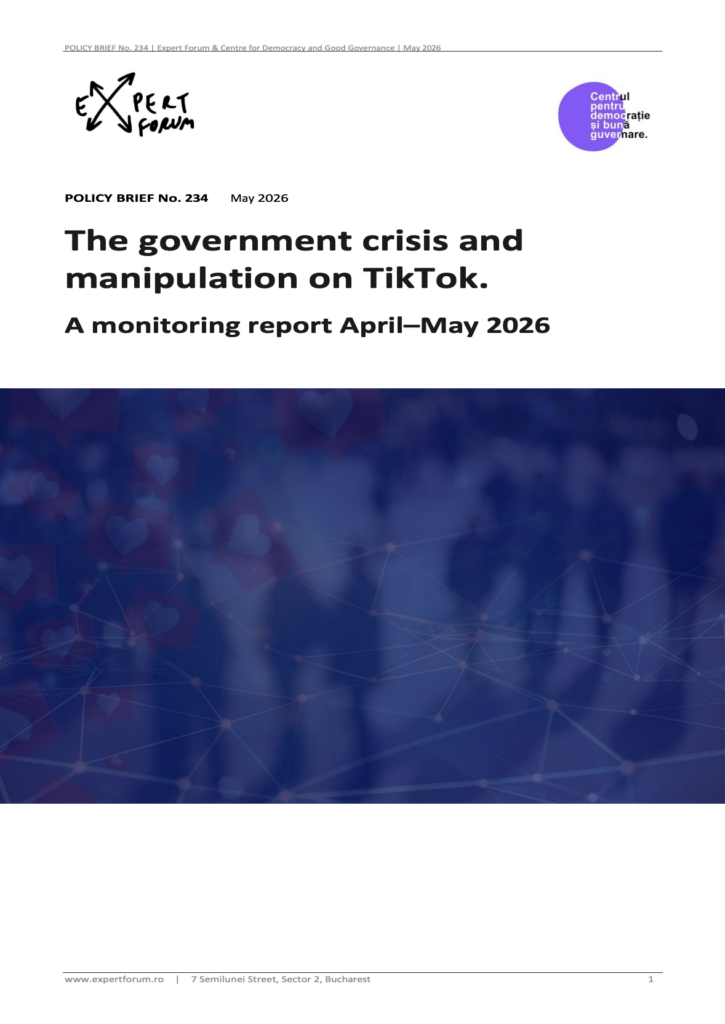
Monitoring Report: April–May 2026
Authors: Mădălina Voinea (Digital Programs Coordinator, Expert Forum), Vlad Adamescu (Co-Chair, Center for Democracy and Good Governance), Monirul Hassan (Independent Researcher, Computer Science)
In a period of political crisis, Romanian TikTok feeds have become an information battlefield. The researchers analysed 23,599 viral political videos from the beginning of the year. Of these, in the period 1 April – 11 May 2026 alone, the monitored videos generated 101.9 million views, 829,000 shares, and 68,400 comments. 52% of comments were identical messages. Of the 267,799 followers of the accounts that produced this content, 53.1% were empty accounts with no videos posted. Are we talking about real people, concerned citizens, patriots? Our data suggests the continuous presence of amplification networks that artificially keep the conversation at peak levels precisely at the moments when the public is most vulnerable. We ask ourselves in this context how we can determine who came first — the inauthentic accounts or the genuine supporters? More importantly, who is accountable in a democracy for the manipulation of information reaching citizens?
Beyond platform obligations, responding to information pollution requires action at the societal level. In this report, the authors propose three complementary directions:
Subscribe to our
newsletter
Sign up for our monthly newsletter
and receive the latest EPDE news
Subscribe to our
newsletter
Sign up for our monthly newsletter and receive the latest EPDE news