
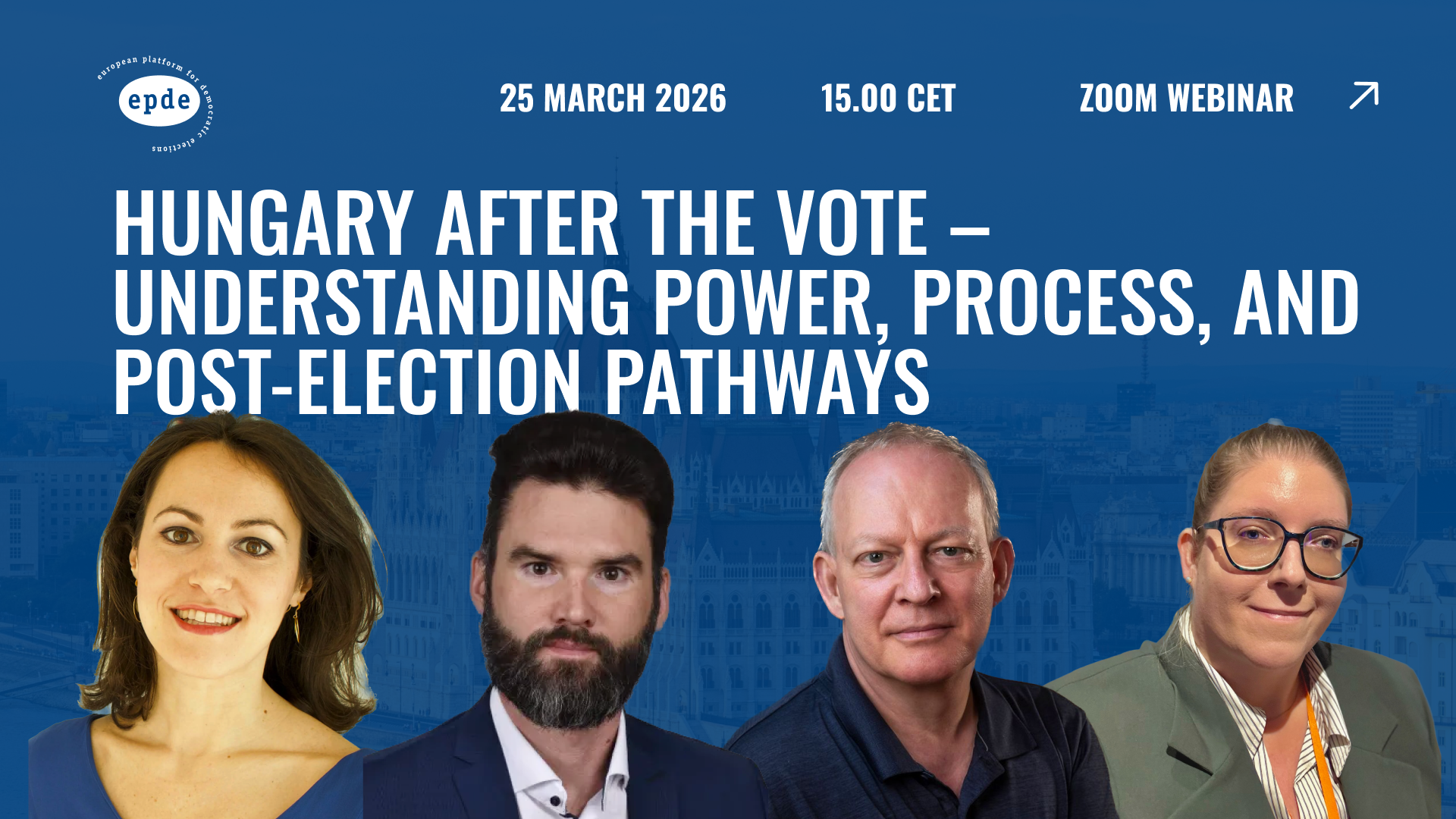
On 25 March 2026, the European Platform for Democratic Elections hosted the webinar “Hungary After the Vote — Understanding Power, Process, and Post-Election Pathways”.
Hungary’s upcoming parliamentary elections are shaping up to be a pivotal moment for the country’s political future. With polls pointing to a competitive contest, important questions remain not only about election day itself, but also about what may follow.
This webinar explored possible post-election scenarios and the challenges that may arise in the period after the vote. From the timing of results to the handling of legal disputes, recounts, or political uncertainty, the discussion looked at how Hungary’s institutional framework could shape the post-election environment.
Key questions included:
Bringing together regional experts and practitioners, the discussion offered a forward-looking, non-partisan assessment of Hungary’s post-election landscape.
Details:
Speakers:
Zsófia Banuta is the co-founder and director of Unhack Democracy, a nonprofit organization that promotes electoral integrity and empowers civil society across Europe. The organization’s work includes initiatives to educate and mobilize voters with a focus on Hungary. Recognizing the evolving challenges to democratic systems of government, at Unhack Democracy, Zsófia pioneered REWIRE, a hope-based mindset shift incubator that uses neuroscience, entrepreneurship, and creativity to develop innovative and impactful democracy-building projects. REWIRE supports civil society leaders from various countries in developing human-centered, decentralized initiatives that focus on building a shared vision for the future.
Daniel Hegedüs serves as Deputy Director for the Institut für Europäische Politik (IEP) in Berlin and is affiliated as senior visiting fellow with The German Marshall Fund of the United States and as associate researcher with the Democracy Institute of the Central European University.
His research focuses on democratic and rule of law backsliding within the European Union, the intersection of autocratization and foreign policy, and the European and foreign affairs of the Visegrad countries. He studied political science, history, and European law at Eötvös Loránd University in Budapest and Humboldt University in Berlin. Before joining IEP in 2026, he held various management, research, and lecturer positions at institutions including The German Marshall Fund, the German Council on Foreign Relations (DGAP), the German Institute for International and Security Affairs (SWP), Freedom House, the Institute for Eastern European Studies at the Free University of Berlin, Humboldt University of Berlin, and Eötvös Loránd University. Daniel is the author of more than 80 academic and policy papers and is a frequent contributor to international media.
Gábor Tóka is a Senior Research Fellow in the Vera and Donald Blinken Open Society Archives at the Central European University, Budapest, Hungary, where he is the curator of a thematic collection of surveys of social and political attitudes. He specializes in the comparative study of voting behaviour, political attitude formation, and political communication and is particularly interested in how the democratic process and mass media can assist citizens in producing election outcomes that faithfully reflect their underlying preferences. His current research interests also include gerrymandering and non-partisan districting, the long-term impact of electoral turnout on election outcomes and public policy, the impact of discursive practices on attitudes towards disliked and/or disadvantaged groups, and developing conceptual and empirical distinctions between civil versus uncivil forms of partisanship.
Zosia Lutkiewicz is a democracy and civil society expert focused on electoral integrity and citizen engagement across Europe and globally. As President of the Political Accountability Foundation (PAF), she leads Poland’s non-partisan election observation efforts and promotes comprehensive electoral reform. She serves on the boards of the European Platform for Democratic Elections (EPDE) and the Global Network of Domestic Election Monitors (GNDEM) where she works to tackle global threats to election integrity. Her experience advancing democracy and civil society development in Belarus, Russia, and Uzbekistan, including from the EU level, informs her strategic, values-driven approach grounded in non-partisanship, solidarity, and civic empowerment.
Subscribe to our
newsletter
Sign up for our monthly newsletter
and receive the latest EPDE news
Subscribe to our
newsletter
Sign up for our monthly newsletter and receive the latest EPDE news
